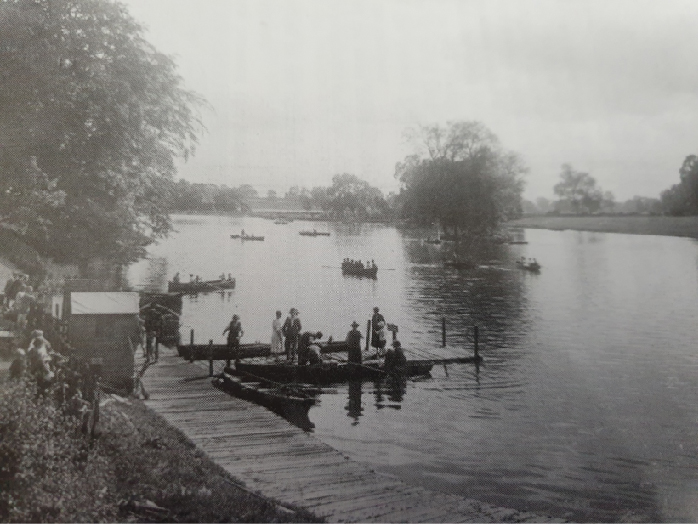
Due to its lack of use during the war, the boating lake had deteriorated and had now become expensive to maintain. Regular dredging operations had to be made to remove silt. The boating lake filled in income from boating charges fell far short of the cost of repair and maintenance. It was therefore decided to fill in the lake and re-landscape the areacxi. After filling in, the ground was left to settle for some fifteen years.
Partly due to its lack of use during the war, the boating lake had deteriorated and had now become expensive to maintain. Also, regular dredging operations had to be carried to remove silt. The silt was mainly composed of coal dust and believed to have originated from some
collieries far upstreamcii.
The Council discussed various proposals as to what do with the site. The expense of constructing a new lake, around £30,000, could not be justified. It was realised that if the lake was filled in and the area was to be re-landscaped, it would take at least ten years for the ground to settle before it could be laid out for some other use. In the end, no decision was reachedciii.
The long awaited boating lake extension was finally implemented, using most of the newly acquired Polam Hill site. The total cost was £7,200. An employment grant of £3,800 was provided by the government for the schemelxxi.
The original boating lagoon in the old part of the park was retained for another ten years or so.
The Council discussed a proposal to enlarge the boating lake and extend the parklx. Work was to be carried out by unemployed workers. New land was to be acquired from Sir Henry Havelock-Allen, who agreed to accept a low price of £50 per acre. However, the scheme did not get underway until 1921.
We use cookies to enhance your experience while using our website. If you are using our Services via a browser you can restrict, block or remove cookies through your web browser settings. We also use content and scripts from third parties that may use tracking technologies. You can selectively provide your consent below to allow such third party embeds. For complete information about the cookies we use, data we collect and how we process them, please check our Privacy Policy