
South Park History

Park House Built

A cottage, which became known as Park House, was built for the resident park keeper. It had been planned in 1851 but insufficient money was available at that time. It..Read More
Darlington Recreational Society formed.

The Darlington Recreational Society was formed. It began to use the park for music concerts and sports events such as quoits xxii. Refreshments were often available
Tearoom Added

It was decided to build another cottage within the park, near the southeast entrance. This became known as East Lodge. Like Park House, the new building was constructed of “Pease”..Read More
Cannon Added

A cannon gun from the Crimean War was set in position as a permanent exhibit. Many such guns, which were no longer required by the government, were handed out to..Read More
Victoria Embankment

A new road, Victoria Embankment, was built alongside the river, towards the north end from the town centre. Prior to this, the park had been fairly remote from any built-up..Read More
Fowler Monument

A bronze replica of a steam-powered plough was moved to the park from the garden of Pierremont, which belonged to Henry Peasexliii. The model was made in memory of John..Read More

Footbridge

A new footbridge was built near the Grange Road entrance after the original one had been washed away during heavy flooding
New Bandstand

A new bandstand was built, replacing the earlier wooden structure (which was smaller and whose roof consisted of a canvas awning). It was paid for using the ice skating takings..Read More
The Start of the Aviary

The Council agreed to purchase a collection of foreign birds for the aviary, offered to them by a Mr. John Bowman for £10liv.
Bowling Greens

Two bowling greens were opened. These were the first in Darlington. A bowling club was formed and still exists today

The Boating Lake
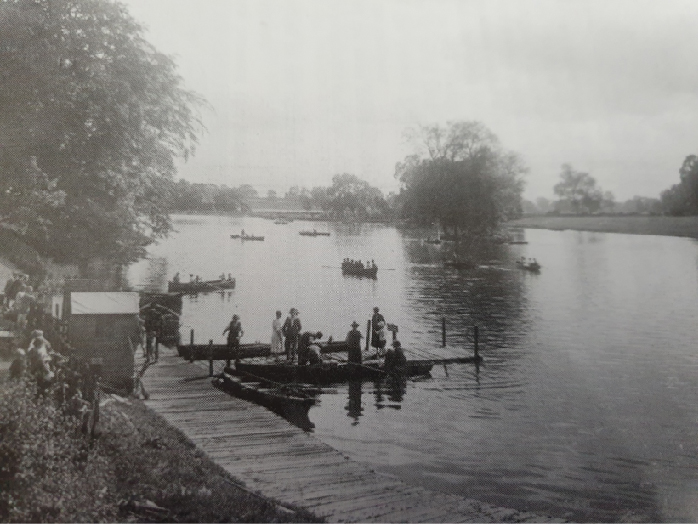
The Council discussed a proposal to enlarge the boating lake and extend the parklx. Work was to be carried out by unemployed workers. New land was to be acquired from..Read More
New Streets
New developments were taking place beyond the northeast side of the park, filling the space between Victoria Embankment and Park Lane with a criss-cross of new streets of terraced houses...Read More
Observatory
An observatory was erected near the bowling greens to accommodate a telescope which had been offered to the Councillxii. The telescope, a five-inch refractor, is thought to be one of..Read More
New Rustic Style Tearoom
A new rustic style tearoom was built replacing the earlier cottage style construction.
Commemorative Oak Trees
Two oak trees were planted to commemorate the coronation of King George Vlxiv. The idea of tree planting ceremonies to celebrate historic events had always been encouraged by the park..Read More
Further Extension
Another piece of land was purchased at a cost of £1,750. This consisted of a fifteen-acre site to the northeast of the parklxvii. Most of this site was eventually cleared..Read More
New Houses & Street Names
The remaining gaps in the rows of terraced houses in the Leafield Road area were filled. Clifton Road and Park Lane were extended southwards, with new-style semi-detached houses. Park Lane..Read More
New Extension to South
The farm immediately south of the park, called Polam Hill, was purchased by the council from Sir Henry Havelock-Allenlxx. It amounted to 77½ acres in total, but not all of..Read More
Boating Lake Extension
The long awaited boating lake extension was finally implemented, using most of the newly acquired Polam Hill site. The total cost was £7,200. An employment grant of £3,800 was provided..Read More
Putting Green
A new 18-hole putting green was opened. It was to be the first of several in the town. The formal opening was well attendedlxxii.

Canon Moved

The Crimean cannon was moved to its present location at the southern edge, near the aviaries.
Observatory

The observatory that had been in the park for nearly thirty years was not a successxcii. Its lack of use was largely due to the fact that the park’s security..Read More
Railway Tracks

A short section of railway track attached to some stone sleepers from the original 1825 Stockton & Darlington Railway were installed as an exhibit near the southern edge of the..Read More
Rose Garden

A formal rose garden was laid out on the west side of the river on what had previously been a derelict site. It was named the Chandler Rose Garden as..Read More
Rose garden sundial
A sundial was purchased from Halnaby Hall to be placed in the new rose garden. Its inscription attributes it to Inigo Jonescx. Only the plinth now survives.
Fowler’s Plough

The model of Fowler’s Plough was stolen from its plinthcxxi. It had been badly damaged some years earlier and was incompletecxxii. A replica has since been made but has not..Read More

The Beginning
A piece of farmland was bequeathed by James Bellasis to a trust who were to ensure that the income from the land be used for charitable purposes i. The site consisted of four fields, with a total area of 20 acres, situated along the southern edge of the town boundary ii. The land became known as “Poor Howdens” estate and was administered by a Trust consisting of the Vicar of St. Cuthbert’s Church and other local officials iii.
New Path Constructed
Access to the site was improved when a new path was constructed from Grange Road (although it is not known how the River Skerne was crossed)iv. Previously, the only access to the estate was at the southeast corner, via a path from Neasham Roadv. The new path across the Polam Hall estate was bought for £20 vi. A house was build adjoining this path about the same timevii. It became known as South Villa and later as Neasham House viii.
Public Recreation Ground
The Town Commissioners held a meeting where it was decided that the Poor Howdens estate should be appropriated for use as a public recreation ground. The initiative for such a scheme probably originated in the growing awareness of the issue of public health. The consent of the Trustees of the land was sought.
Park Design Decided On
The Poor Howdens Charity had been set up to encourage the woollen and linen industry. In practice, this consisted of offering loans at reasonable rates to small businesses in these trades ix. By the nineteenth century, this was no longer necessary as the industry had come to be dominated by large companies. After reconsidering the charity’s role, the trustees agreed to the recommendation that the land should become a park.
Previously, the main access to the site was at the southeast corner, via a path from Neasham Road. The path was now made wider, in order to allow carriages to pass, but this did not solve the problem of the site being effectively remote to the general public. To rectify this, a footbridge was constructed over the river, connecting to a path on the Polam Hall estate, adjacent to Neasham House, providing access from Grange Roadx. Consequently, the site now became within easy reach for many more people and the potential for development as a park became more likely.
The new Committee of Darlington Public Park invited designs for a suitable layout for a park xi. It is not known how many were submitted or whose design was chosen, but it is evident that at least two designs were considered xii.
Land Leased
It was agreed the land was to be leased to the Board of Health at £32 per annum for 21 years for use as a park xiii.
First Paths & Trees Planted
The transformation of the land was administered jointly between the Trustees of the estate and the local Board of Health. After much discussion, the land was drained and then laid out and planted with trees. Paths were constructed using 100 tons of furnace slag that had been donated by Joseph Peasexiv. Some of these paths still survive (although they are now surfaced with tarmac), notably the straight-line path near the southern boundary.
At this time, the idea of a public park was very much a novelty. The nearest one was in Manchester and this had only been open since 1846. There were several in London, but these were all laid out while still in private ownership before being acquired by public authorities. A public park created from scratch was still a rarity. The earliest example of this was Birkenhead Park in Liverpool which had opened in 1843.
It is not known who designed the layout.
Path Widened
Robert Henry Allen, the owner of the Polam Hill estate immediately to the south of the park, complained to the Trust about a stile that had been installed, giving access to his land. He demanded that it be removed.
It was complained that the access path from Grange Road was too narrow and it was therefore widened after a further small strip of land was bought xv. It was also intended that an access be made on the north side to the Bank Top area xvi. This does not seem to have been carried out.
Park Officially Opened
After various setbacks which were largely due to poor weather conditions xvii, the park was officially opened. The actual date of opening is unknown. It was the first public park in the North East of England. It became known by several names – Bellasis Park, The People’s Park, New Park, Victoria Park and even simply The Park – before finally settling on the name South Park xviii.
For a while, the adjacent township of Blackwell claimed that the land fell within their jurisdiction and that rates should be paid to them rather than to Darlington xix. There may be some justification for this depending on whether the site was originally part of the Polam Hill estate immediately to the south or of another estate to the north. Different maps from around this period show the boundary either along the north edge or the south edge of the park. A survey commissioned by the Council and carried out in 1829 includes the land as lying within the Darlington township xx. The first edition Ordnance Survey map of 1856 agrees with this. Some other maps disagree however, notably a Borough Surveyor’s plan dated 1852xxi, which shows the boundary on the north edge and therefore putting the park in Blackwell.

Park House Built
A cottage, which became known as Park House, was built for the resident park keeper. It had been planned in 1851 but insufficient money was available at that time. It included a viewing tower and a refreshment room. It was and still is regarded as the main focal point of the entire park. The building was constructed with a type of white brick that is nicknamed the “Pease” brick. These are featured in many Darlington buildings that were built between approximately 1850 and 1875. Unfortunately, the brickwork on the main faces of the house has since been painted over.

Darlington Recreational Society formed.
The Darlington Recreational Society was formed. It began to use the park for music concerts and sports events such as quoits xxii.
Refreshments were often available
Tearoom Added
It was decided to build another cottage within the park, near the southeast entrance. This became known as East Lodge. Like Park House, the new building was constructed of “Pease” bricks. It was also decided to incorporate into the design a shed which had previously stood in the market place xxvi.
A cottage style tearoom was added to the south side of Park House. Prior to this, part of the house itself had been used as a café.
Cannon Added
A cannon gun from the Crimean War was set in position as a permanent exhibit. Many such guns, which were no longer required by the government, were handed out to towns throughout the country xxiii. It was initially placed near Park House on the terrace xxiv. Darlington’s Theatre Royal gave a special performance to raise funds for the mounting xxv.
Terrace of Trees Planted
A terrace of trees was planted near Park House to celebrate the marriage of Prince Edward xxvii. This included two Wellingtonias, which eventually became quite large, the growth of the multi-stems having reached a rate of one foot per annum at one time xxviii.
Victoria Embankment
A new road, Victoria Embankment, was built alongside the river, towards the north end from
the town centre. Prior to this, the park had been fairly remote from any built-up area. This
road was later to become the main approach road to the park, although at this time there was
still no access on the north side xxix. Initially trees were planted on both sides of the street, but
those on the east side were later removed xxx.Before constructing the new road Victoria Embankment, the river course along this section
was straightened. Material dug up during the construction of a lake in the adjacent Little
Polam estate is believed to have been used for the re-landscaping of this area. This estate
was to be later incorporated into the parkLease Expired
After the 21 year lease expired, the Corporation made a decision to continue to maintain the park.
The new rental was to be a much higher figure of £90 per annum, so an offer was madeto purchase the land for £2,250. It was valued at £3,900, but a compromise was eventually reached and a figure of £3,075 was agreed.
It was nearly 3 years before the deal was finalised.
Drinking Fountain
A drinking fountain was installed in the park, having been originally erected in Bondgate in 1860, but removed because of traffic problems. It was paid for by public subscription and dedicated to the late Dr. John Fothergill, who had been the first president of the Darlington Total Abstinence Society xxxi.
Darlington Corporation become Owners
Darlington Corporation became the owner of the land xxxii. The money paid to the Poor Howdens charity trust was used to provide grammar school scholarships.
Little Polam is purchased
A 24-acre site immediately north of the park, known as Little Polam, became available due to the bankruptcy of its owner, William Thompson. The Council offered to purchase this land for the purpose of extending the park
New Extension
The purchase deal was completed and the new site became absorbed into the park, more
than doubling its previous size and bringing it nearer to the town. The cost of the land was
£3,800. Unlike the initial piece of land that had been converted from farmland, this newly
acquired site was already used for recreational purposes and had been laid out during the
1870’s with many features which would be retained. This included an ornamental lake, a
grotto and several avenue walkwaysxxxiii. Some of the land had been used as an orchardxxxiv.
Other parts of it was overgrown with thistles and nettles and it was several decades before the
last of it was eventually clearedxxxv.The lake was supplied with water via a pipe from the river. This pipe passes under the grotto
and also fed into the grotto’s pondxxxvi. This pond has since been filled in, but the lake has
survived and still is one of the park’s most popular featuresxxxvii.At the north end was a lodge which had presumably also been built by the recent owner,
William Thompson. It was then called Little Polam Cottagexxxviii but is now known as
Embankment Lodge.New Layout
A few new walkways were laid out, integrating the new section with the old. Many of the
walkways in the new section that had been established by the previous owner were retained.
There was a drop in level between the existing park and the newly acquired section. The
difference was easily accommodated by extending the terraced structure that had been
established thirty years earlier.It was popular at the time for walkways to be planted at one or both sides by an avenue of
trees. It would have been convenient to make use of existing rows of trees wherever they
existed and to construct paths alongside these. It is evident that this did occur, since there are
at least two such avenues which follow precisely the lines of the original field boundariesxxxix.
One of these follows the boundary between the original and the new sites. These boundaries
would have been marked by hawthorn hedging interspersed with trees, probably ash and
elmxl. Presumably, during the re-landscaping of 1880-2, the hedging was removed and the
remaining trees used as a basis for the new layout. Over the years, many of the trees will
have been replaced, but the line that they follow has been retained. Hence, certain sections of
these field boundaries, which may be several centuries old, can still be clearly identified.Much of the layout of the park as it was in 1882 has survived intact to the present day. One
notable exception is the showfield, which has since been greatly extended, but at that time had
not yet been established. Another major difference is that there now many more tall trees and
therefore fewer uninterrupted views. However, despite all the various constructions and
artefacts that have been added over the decades, each of these have blended fairly well into
the landscape without upsetting the overall balance. Nor have the later extensions had any
significant impact on the older parts, since (with the exception of the showfield) these are
hardly visible from the main section. The heart of the park as we see it today is essentially
only a more mature version of what it was in the 1880’s.
Fowler Monument
A bronze replica of a steam-powered plough was moved to the park from the garden of
Pierremont, which belonged to Henry Peasexliii. The model was made in memory of John
Fowler whose design of the original instrument, on which this model was based, had won a
first prize at a royal showxliv. Fowler, who died in 1864, was married to one of the daughters of
the former M.P., Joseph Peasexlv.James Morrison
A new Park Superintendent, James Morrisonxli, was appointed. He was to remain in this post
for 44 years, residing at Park House. During his tenure, he planted many trees and introduced
a great variety of new plants into the park. He was probably most famous for his annual floral
displays on the terraces alongside the river. Each year, he created a different display, usually
illustrating a topical theme. The practice still continues today. Some of his displays consisted
of portraits of famous people, notably Queen Victoria in 1897 (jubilee year) for which he
received a letter of acknowledgement from the Queenxlii.New Entrance
A new entrance was constructed at Victoria Embankment, next to Polam Bridge, with both
single and double gates xlvi. After the opening of the new section, some of the well to do would
drive into the parks in their carriages. Some of the less well off protested at this, arguing that
the park was for the benefit of poorer people. They were overruled by the authorities, whose
view was that the park was intended for the rich and the poor alike xlvii.
This entrance was regarded as the main entrance for the next 45 years.Lagoon
A lagoon was constructed off the river at the southwest corner to allow boating xlviii. The new
landscaping interfered with a crossing point at what had previously been the main entrance.
An additional footbridge was therefore needed across the lagoon. It was constructed
alongside the southern boundary. A footpath along a narrow island connected the two
bridgesxlix.New Extension Completed
The new extension was to be officially opened with a formal ceremony, but the Council did not
wish to spend any money on such a function. As it happened, the park was already very
popular and no extra publicity was required.Bandstand
A bandstand was erected during the summer and thousands of people gathered to listen to the
music at the first opening. One councillor expressed horror that dance music had been played
on a Sundayl.Tennis Courts
The first tennis courts were opened.
Footbridge
A new footbridge was built near the Grange Road entrance after the original one had been washed away during heavy flooding
Darlington Cattle Show
The annual Darlington Cattle Show was held in the park, for the first time, on the new showfield. It continued to be held here each year and later evolved into the Darlington Showlii
New Bandstand
A new bandstand was built, replacing the earlier wooden structure (which was smaller and
whose roof consisted of a canvas awning). It was paid for using the ice skating takings which
had been exceptionally high after the ornamental lake had been frozen over for more than six
weeksliii.The bandstand is now Grade II listed.
The Start of the Aviary
The Council agreed to purchase a collection of foreign birds for the aviary, offered to them by
a Mr. John Bowman for £10liv.
Bowling Greens
Two bowling greens were opened. These were the first in Darlington. A bowling club was
formed and still exists todayBoulder
A large sharp granite boulder, taken from the River Tees near Winston, was installed in the park as a memorial to Dr. R.T. Manson, a well-known scientific and literary authority with a special interest in geology lv. The stone is believed to have originated from Westmorland and
to have been swept down Teesdale by a glacier during the Ice Agelvi. It weighs four tons. Part of the chain that was used to lift the stone during its transportation is preserved in Darlington Museum.The Clock
A four-face clock was donated to the town by William Potts, a Leeds clockmaker, in memory of his late father who had lived in Darlington. It was installed in the tower of Park Houselvii. The clock tower had originally been built for viewing the park but this function was now lost. The new clock, however, enhanced the character of the building as a main focal point.
Kites
A pair of African kites were presented by Mr. A.W. Trees to be kept in the parklviii.
Two Oak Trees
Two oak trees were planted to celebrate the coronation of King Edward VII.
Animals
Three monkeys were donated to the park by a Darlington resident. Part of the greenhouse was converted to house these animals during the winter monthslix. Another member of the public presented 14 canaries for the aviary.
The Boating Lake
The Council discussed a proposal to enlarge the boating lake and extend the parklx. Work was to be carried out by unemployed workers. New land was to be acquired from Sir Henry Havelock-Allen, who agreed to accept a low price of £50 per acre. However, the scheme did not get underway until 1921.
New Streets
New developments were taking place beyond the northeast side of the park, filling the space between Victoria Embankment and Park Lane with a criss-cross of new streets of terraced houses. Some of these streets, e.g. Leafield Road, were not finally completed until after the
warlxi.Observatory
An observatory was erected near the bowling greens to accommodate a telescope which had been offered to the Councillxii. The telescope, a five-inch refractor, is thought to be one of the finest of its kind made around that timelxiii.
New Rustic Style Tearoom
A new rustic style tearoom was built replacing the earlier cottage style construction.
Commemorative Oak Trees
Two oak trees were planted to commemorate the coronation of King George Vlxiv. The idea of tree planting ceremonies to celebrate historic events had always been encouraged by the park superintendent, James Morrison, as a way of increasing the tree stock without spending
money from his maintenance budget.Tank
A tank from the First World War was presented by the National War Savings Committee to the citizens of Darlington in recognition of the readiness with which they had lent their support to the war effortlxv. It was placed near the Victoria Embankment entrancelxvi
Further Extension
Another piece of land was purchased at a cost of £1,750. This consisted of a fifteen-acre site to the northeast of the parklxvii. Most of this site was eventually cleared of all trees and obstacles and is now part of the showfield.
A footpath which ran along the edge of the site was retained as a public right of waylxviii. It was fenced off so that it remains accessible when the park is closed. Beyond this was some land used as allotment gardens. Part of this has since been built on, but most of it remains as
allotments.New Houses & Street Names
The remaining gaps in the rows of terraced houses in the Leafield Road area were filled. Clifton Road and Park Lane were extended southwards, with new-style semi-detached houses.
Park Lane follows the line of an ancient footpath and is so named because the land along which it skirts was formerly known as the High Parks. Its name and its proximity to the park is entirely coincidental. Similarly, Park Place and Park Street had been built in the 1830’s on
land known as the Low Parkslxix. Unlike these, the road which eventually became known as Parkside was developed and named long after the park was established, was named in accordance with its location adjacent to the park.New Extension to South
The farm immediately south of the park, called Polam Hill, was purchased by the council from Sir Henry Havelock-Allenlxx. It amounted to 77½ acres in total, but not all of it was to be designated for parkland.
Boating Lake Extension
The long awaited boating lake extension was finally implemented, using most of the newly acquired Polam Hill site. The total cost was £7,200. An employment grant of £3,800 was provided by the government for the schemelxxi.
The original boating lagoon in the old part of the park was retained for another ten years or so.
Putting Green
A new 18-hole putting green was opened. It was to be the first of several in the town. The formal opening was well attendedlxxii.
Neasham House
Neasham House (205, Grange Road) was purchased by the Council from George Wells Jennings at a cost of £2,850lxxiii
Parkside
The remainder of the Polam Hill site was used for a new road (now called Parkside but then known as Geneva Road), which was constructed along the south edge of the park, running east west and linking Grange Road with Neasham Road. Its construction included a bridge
over the Skernelxxiv, with wall and piers constructed of sand-faced hand-made brickslxxv. Some new houses were built, mainly on the south side of the road. The park (excluding the new boating area) was now enclosed on three sides by residential housing.New boating lake completed
The new 22 acre boating lake was finally completedlxxvi. Six new boats were purchased before the openinglxxvii.
Fountain
A fountain was installed inside the park, on the edge of the sub-tropical garden near the ornamental lake, having been originally erected in South Pierremont for Henry Pease around 1872. It was donated to the park by Cuthbert Todd, a builder who had purchased a section of
the Pierremont estate in which the fountain stoodlxxviii. The structure weighs over ten tons, so deep foundations were requiredlxxix. At the opening ceremony, Alderman Crooks said he hoped it would flow until the millenniumlxxx. The fountain is currently not functional.Park Superintendent
The long-serving Park Superintendent, James Morrison, finally retired after 44 years. He was replaced by his son Thomas who had been born at Park House and had already spend fifteen years of his life employed working in the park. Unlike his father’s post, this new appointment included responsibility not only for South Park but for all of the Darlington parks. There were 104 applicants for the joblxxxi
New fence and entrance
Ornamental iron fencing was erected along the edge adjoining the new road (then known ascGeneva Road but now called Parkside)lxxxii. In total, it covered a 668 yard stretch from the river bridge to the southeast corner. A new entrance, with ornate pillars and spherical finials,
was constructed near the bowling greenslxxxiii. It has come to be regarded as the main new fence and entranceThe entrance at the southeast corner of the park was also replaced with a new construction.
The new fence followed a smoother curve than the original boundary, diverging by several yards around the section near the new entrancelxxxiv. The old boundary would typically have consisted of a hawthorn hedge interspersed with trees. A line of trees spaced at roughly equal intervals exists just inside the fence along a section towards the east corner. Presumably this is the remains of the old boundary, surviving in similar fashion to other old boundaries elsewhere in the park.
At this time, the park staff consisted of seven people in total.
Canon Moved
The Crimean cannon was moved to its present location at the southern edge, near the aviaries.
Boundary changed
The 1921 extension to the park (containing the boating lake) was previously part of the Township of Blackwell, but subsequently became part of Darlington, following boundary changeslxxxvi.
Ticket Office
The system for taking money for the games was formalised when a ticket office was erected near the new main entrance and new staff were employed over the summer months to run itlxxxvii.
Children’s Playground
A children’s playground was installed. The cost of the equipment was £238lxxxviii
Motorboats banned on the river
The Council decided that motor boats were to be banned from the river and used on the main lake onlylxxxix.
Lagoon filled in
The lagoon that had been the original boating lake was filled in and re-landscaped
Rockery Extension
An area west of the river, adjacent to Grange Road, was added to the parkxc. A rockery was constructed in the centrexci. Two new entrances were constructed to this new section, one at Grange Road and one at Parkside.
New Avaries
New aviaries were opened along the path which runs along the southern edge. They were so constructed that rats, which were alleged to have overrun the old aviaries, could not gain access.

Observatory
The observatory that had been in the park for nearly thirty years was not a successxcii. Its lack of use was largely due to the fact that the park’s security arrangements conflicted with one of the main requirements for an observatory, i.e. that users can gain access at nighttime and at short notice whenever the weather conditions are favourable. This was not the case, with the park being locked during hours of darkness and the park’s superintendent not being contactable. Some steps were taken to rectify this, by giving extra sets of keys to other individuals, but it still proved unsatisfactory. In the end, the observatory was removed and resited on the Grammar School playing field near Westbourne Grovexciii. It became frequently used by the Darlington Astronomical Society. Sadly, in the 1990’s, it was gutted by fire and the telescope was damaged beyond repairxciv.
The surviving lenses and fittings are in the care of Darlington Sixth Form College.
New toilets
New public conveniences were built at the south edge.
Arch
A stone arch, which had formed part of the Bishop’s Palace in Lead Yard, was planned to be moved and installed in the grottoxcv. The Palace, which was demolished in the 1960’s to make way for the new town hall, dated back to the twelfth century. Sadly, there is no sign of the arch
in the park now so it was probably never installed. A stone arch at the entrance to the grotto is evidently not the one referred to here as it can be seen in the background on an etching from circa 1890xcvi.Skating Rink
A roller skating rink was constructed next to the bandstand. A ticket office with turnstile was built, presumably at the same time.
New footbridge
A new footbridge over the River Skerne was built after the lagoon had been filled in and this section of the river straightenedxcvii. The foundations of this bridge remain as part of the current structurexcviii.
There have been several pieces of land added to the park since it first opened, but only one occasion where some land was taken away. It was with the advent of the new section west of the river and the construction of a new footbridge connecting this section to the main body of
the park that the original access path from Grange Road was no longer required. It was blocked off and, from then on, was no longer part of the park. Currently, only the first 40 metres of this path is in use as an access to a modern block of flats (No. 199, Grange Road).Further along, it is overgrown and derelict. The land does not belong to the Council and it has not been possible to trace the ownershipxcix.
Bedford Street Entrance
An entrance at Bedford Street was planned with ornate gates and pillarsc. However, presumably because of the war, only a pair of plain gates was constructed.
Blackwell Mill
Blackwell Mill, an old disused building on the edge of the boating lake, was demolished, despite opposition from the Darlington Society of Arts. An earlier structure on this site is believed to date back to the fourteenth century or earlier.
Tank
The First World War tank was broken up for scrap for the new war effort. The plaque belonging to it is now in Darlington Museum.
The site of the tank was used as a collection point for scrap metal. Most of this came from railings from domestic front gardens. Some railings were taken from public parks. South Park railings survived, however.Playing Field during the war
Most of the playing field was temporarily ploughed over and used to grow vegetables for the war effort.
New Parkside Entrance
New entrance gates & pillars were planned to replace an older entrance at the southeast corner near East Lodge. This was apparently not implemented, as only a pair of plain gates exists there today. One brick pillar still survives, however. Like the two early lodges, it is
constructed of “Pease” bricks and therefore was probably part of the original entrance that was constructed in 1851.Greenhouses
Some new greenhouses were erected
Boating Lake
Partly due to its lack of use during the war, the boating lake had deteriorated and had now become expensive to maintain. Also, regular dredging operations had to be carried to remove silt. The silt was mainly composed of coal dust and believed to have originated from some
collieries far upstreamcii.The Council discussed various proposals as to what do with the site. The expense of constructing a new lake, around £30,000, could not be justified. It was realised that if the lake was filled in and the area was to be re-landscaped, it would take at least ten years for the ground to settle before it could be laid out for some other use. In the end, no decision was reachedciii.
Lily Ponds
Lily ponds were constructed at the centre of the grottoci replacing the large pond. Presumably, these were fed from the same pipe as the previous pond. Some time after, the lily ponds were filled in with soil.
Park Superintendent retires
The Parks Superintendent Thomas Morrison retired. The post had been in his family since his father was appointed in 1881civ.
Trees planted
Some trees were planted on the west section to commemorate the Festival of Britaincv. Decorative lighting was installed around the bandstand and elsewhere for the event and was retained for a few years after.
Trees preservation order
Tree Preservation Orders were placed on many trees in the area. South Park was largely excluded from this except for three trees along the southwest edge of the boating (now pitch & putt) areacvi.
Railway Tracks
A short section of railway track attached to some stone sleepers from the original 1825 Stockton & Darlington Railway were installed as an exhibit near the southern edge of the parkcvii.
Rose Garden
A formal rose garden was laid out on the west side of the river on what had previously been a derelict site. It was named the Chandler Rose Garden as a tribute to Alderman W.G. Chandler, chairman of the Parks Committee. 800 rose bushes were plantedcviii.
In this section, part of an earlier path with stone steps still survives. It probably originally lay inside the garden of Neasham House (No. 205, Grange Road), which was built sometime around the 1830’s.
Animals added to Aviary
Various animals – including rabbits, guinea pigs, goldfish and doves – were donated for the aviary by members of the publiccix
Rose garden sundial
A sundial was purchased from Halnaby Hall to be placed in the new rose garden. Its inscription attributes it to Inigo Jonescx. Only the plinth now survives.
Lake filled in
Due to its lack of use during the war, the boating lake had deteriorated and had now become expensive to maintain. Regular dredging operations had to be made to remove silt. The boating lake filled in income from boating charges fell far short of the cost of repair and maintenance. It was therefore decided to fill in the lake and re-landscape the areacxi. After filling in, the ground was left to settle for some fifteen years.
Skating Rink resurfaced
The skating rink was re-surfaced and slightly extendedcxii
New Ornamental Entrance
A new ornamental entrance was constructed off Parkside near the children’s playground.
Fence moved
The fence adjoining Grange Road on the former boating lake area was set back further from the roadcxiii.
Angling
The Council approved a proposal to allow the ornamental lake to be used for angling. The Darlington Brown Trout Association agreed to stock the lake with fishcxiv.
Skerne Park estate
New council houses were built south of Parkside (Skerne Park Estate).
New footbridge
The rustic style footbridge over the Skerne was replaced by a new concrete constructioncxvi. The foundations of the previous structure were retained.
Dog Show
The first dog show was held. It has been repeated every year since and has now become a two-day eventcxvii.
Pitch & Putt
A new pitch & putt course was laid out on the site of the former boating lakecxviii. Some of the land was set aside for other uses, e.g. for picnicking. A car parking area was also considered but never constructed.
Children’s Boating Pool
A children’s miniature boating pool was constructed near the ornamental lakecxix.
Listed Buildings
The bandstand and the fountain became Listed Buildings, as did Neasham House and its front boundary wallcxx.
Fowler’s Plough
The model of Fowler’s Plough was stolen from its plinthcxxi. It had been badly damaged some years earlier and was incompletecxxii. A replica has since been made but has not been placed in the park for fear of theft and vandalism. The granite plinth still remains.
Rock Festival
The Council agreed to allow an open-air rock festival to take place in the parkcxxiii.
Repairs to the Fountain
Repair and restoration work was carried out on the fountain after it had been damaged by vandalscxxiv.
Award
The park won an award for best park in the Northeast in the annual Northumbria In Bloom horticultural eventcxxv.
Aviary Improvements
A £30,000 scheme to improve the aviary was proposed, following complaints about some of the conditions in which the birds were keptcxxvi.
Darlington Show
The Darlington show was held in South Park for the last time. Due to financial difficulties and security problems, it did not take place in 1993. It has subsequently resumed but at a different venue. It’s future is currently in doubt.
South Park listed by English Heritage
South Park was listed by English Heritage in their Register of Parks & Gardens of Special Historic Interestcxxvii. The 200 municipal parks included here are given statutory recognition.